Vietnam Tightens Checks on Acoustic Panel Fire Certificates
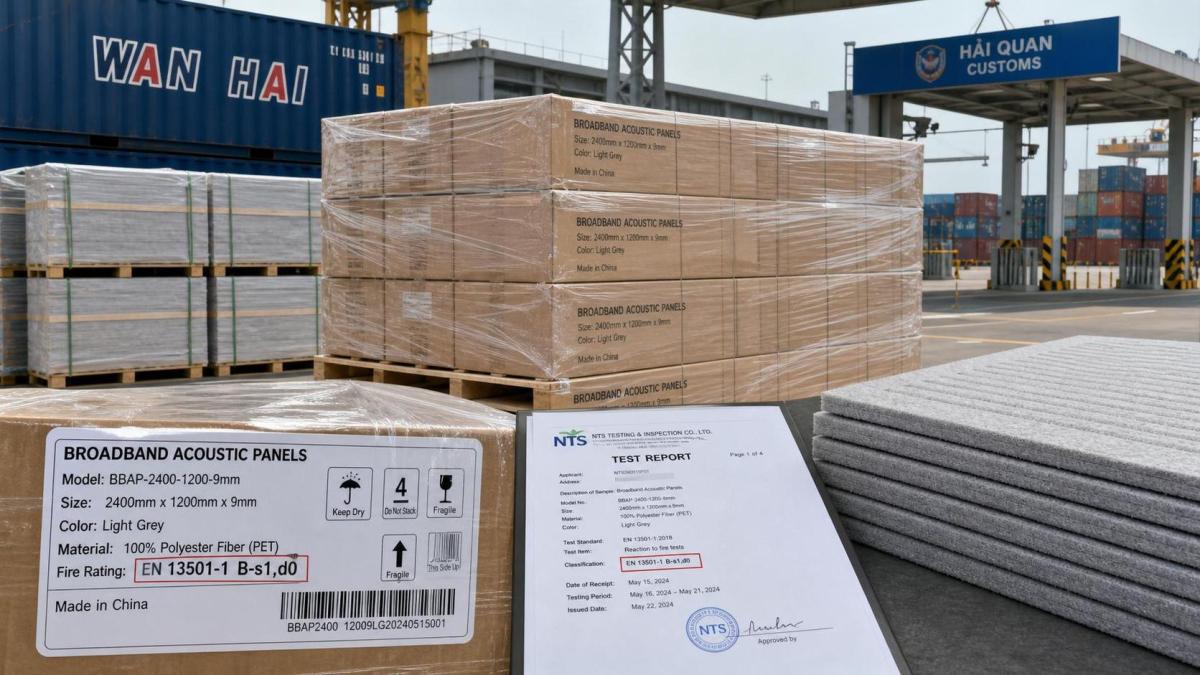
On July 15, 2026, Vietnam moved to tighten import scrutiny on Broadband Acoustic Panels through a 90-day intensified inspection program under Joint Notice No. 118/2026/TT-BCT issued by the Ministry of Industry and Trade and the General Department of Customs. The measure puts the authenticity of EN 13501-1 B-s1,d0 fire-rating certificates and the consistency of Chinese-language labels at the center of customs review, making this a matter of immediate concern for exporters, importers, distributors, inspection service providers, and project-based buyers across Southeast Asia because clearance timing, compliance cost, and delivery schedules may all come under pressure.
What the 90-Day Inspection Program Covers
According to the information provided, the Vietnamese authorities began a special inspection of imported Broadband Acoustic Panels on July 15, 2026, with a planned duration of 90 days. The stated focus is twofold: verification of the authenticity of EU EN 13501-1 B-s1,d0 fire classification certificates, and checks on whether Chinese-language labels are consistent with the relevant compliance information.
The same information indicates that some Chinese exports had previously faced a return rate of 17% because labels did not include the B-s1,d0 marking. It also states that the new inspection drive is expected to lengthen customs clearance cycles and add third-party inspection costs.
Where the Immediate Pressure Is Likely to Appear
Export-facing trade flows may face document risk first
From an industry perspective, companies directly involved in cross-border shipments are likely to feel the first operational impact because customs review is centered on certificate authenticity and label consistency. The main pressure point is not only whether a shipment has a certificate, but whether the supporting documentation and product labeling can withstand closer inspection during clearance.
Distributors may see inventory turnover slow down
For Southeast Asian distributors, the issue is likely to show up in stock planning and order rhythm. The provided information specifically notes that inventory turnover may be affected, which suggests that distributors handling project-linked or time-sensitive panel supply will need to pay closer attention to buffer stock, replenishment timing, and the risk of delayed goods at entry points.
Inspection and logistics service providers may face higher coordination demands
Observably, third-party inspection costs are expected to rise under the intensified checks. That creates added coordination work for customs brokers, inspection firms, and logistics partners, especially where shipments require additional document validation or relabeling review before release.
Project buyers may need to watch delivery timing more closely
For downstream buyers using Broadband Acoustic Panels in ongoing projects, the main issue is schedule reliability. The information provided notes possible disruption to project delivery tempo, so procurement teams and contractors may need to monitor whether imported materials can still arrive within expected installation windows.
What Companies Should Watch During the Inspection Window
Certificate authenticity is now a practical clearance issue
What deserves closer attention is that EN 13501-1 B-s1,d0 documentation is not just a technical file in this case; it is a customs checkpoint. Businesses involved in shipment preparation should therefore focus on whether the certificate set presented for import is complete, internally consistent, and ready for authenticity review.
Label wording and compliance markings need closer review
The earlier return cases tied to missing B-s1,d0 markings on labels show that label content can directly affect shipment outcomes. For companies shipping into Vietnam, this means label review should be treated as part of pre-shipment compliance control rather than a secondary packaging task.
Lead times and customer communication may need adjustment
Analysis shows that even where products are compliant, a stricter inspection regime can still extend processing time. Companies handling supply commitments into Vietnam or onward distribution in Southeast Asia should pay close attention to delivery promises, internal scheduling assumptions, and customer communication around possible customs-related delays.
Official wording and actual enforcement should be tracked separately
It is also worth distinguishing between the formal inspection notice and how checks are implemented in day-to-day clearance. Businesses should continue monitoring whether enforcement remains narrowly focused on certificates and Chinese-language labels or whether practical review standards become stricter over the 90-day period.
Why This Matters Beyond a Single Customs Notice
Analysis shows that this development is best read as a targeted compliance signal rather than a fully defined long-term market shift. The authorities have identified two concrete control points, fire classification proof and label consistency, and both sit at the intersection of technical compliance and customs execution. That makes the notice relevant not only to manufacturers, but also to the wider chain of packaging, documentation, inspection, and delivery management.
At the same time, the available information does not yet establish a permanent regulatory change beyond the announced 90-day period. For that reason, it is more appropriate to understand this as an active enforcement phase that deserves close observation, especially if similar scrutiny is later extended to adjacent imported building or interior materials.
How the Market Should Read the Current Signal
At this stage, the Vietnam customs action points to a short-term tightening with immediate operational consequences, while also signaling a broader expectation that technical claims and label content must align more closely in actual import practice. The most balanced reading is that this is neither a routine procedural note nor firm evidence of a lasting structural shift yet. It is a compliance-centered development that can affect clearance speed, cost, and project timing during the inspection window and therefore merits continued attention from companies exposed to the acoustic panel trade.
Basis of This Article and What Still Needs Verification
This article is based on the user-provided news title, event date, and event summary concerning Vietnam's special inspection of Broadband Acoustic Panels starting on July 15, 2026. For this type of industry update, commonly relevant source categories may include official government notices, customs announcements, company disclosures, industry association updates, authoritative media reports, and standard-related documents.
No direct official source link was provided in the input, so the specific official link remains to be further verified. Continued follow-up should focus on whether the 90-day inspection period is extended, whether enforcement wording changes in later notices, and whether customs practice develops beyond certificate authenticity and Chinese-label consistency checks.
Related Intelligence
 Feedback Suppression DSPAug 27, 2026How festival sound system design prevents feedback in large outdoor stagesFestival sound system design prevents feedback through smart speaker coverage, monitor placement, gain structure, RF coordination, and real-world measurement for stable outdoor stages.
 Broadband Acoustic PanelsAug 26, 2026How room architectural acoustics change speech clarity in meeting spacesRoom architectural acoustics directly shape speech clarity in meeting spaces. Discover how reflections, reverberation, and noise affect hybrid meetings—and what to fix first.
 Hydraulic Formed BrasswindsAug 25, 2026When should a player move up to intermediate brass instruments?Intermediate brass instruments can boost tone, control, and confidence—but only at the right time. Learn the key signs a student is truly ready to upgrade.
 Bass Traps & DiffusersAug 24, 2026What actually works for percussion resonance control in small roomsPercussion resonance control in small rooms starts with room treatment, smart kit placement, and selective damping. Learn what truly works to get clearer, tighter drum sound.
 Active DSP Line ArraysAug 23, 2026What makes speaker system design for auditoriums intelligible in the back rowsSpeaker system design for auditoriums determines whether back-row listeners hear clear speech and balanced sound. Learn the key factors behind intelligibility, coverage, aiming, DSP, and room acoustics.
 Class-D Digital AmplifiersAug 22, 2026What drives guitar amplifiers price from practice amps to stage rigsGuitar amplifiers price explained: discover what really affects cost from practice amps to stage rigs, and choose the right amp for your tone, budget, and performance needs.
 AoIP Network ProtocolsAug 21, 2026How to evaluate low latency audio transmission systems for live soundLow latency audio transmission systems for live sound: learn how to compare latency, clocking, redundancy, and network compatibility to choose a reliable, show-ready solution.
 Digital Live Mixing ConsolesAug 20, 2026What drives wireless microphones price differences in live event setupsWireless microphones price varies with RF stability, channel density, battery systems, durability, compliance, and support. Learn how to compare live event setups and avoid costly failures.
 Broadband Acoustic PanelsAug 19, 2026When room acoustics modeling is accurate enough to choose panel placementRoom acoustics modeling becomes decision-ready when inputs, sensitivity checks, and measurements align. Learn when panel placement guidance is truly reliable.
 Broadband Acoustic PanelsAug 18, 2026How much difference do studio acoustic treatment systems make in small roomsStudio acoustic treatment systems can dramatically improve clarity, bass control, and stereo imaging in small rooms. Learn what really works and why better treatment leads to more reliable mixes.
 Neodymium High-frequency HornsAug 17, 2026How neodymium driver magnet structure affects horn clarityLearn how neodymium driver magnet structure shapes horn clarity through flux control, gap design, symmetry, and heat handling—key factors for cleaner speech, sharper transients, and smarter driver selection.
 Active DSP Line ArraysAug 16, 2026How line array coverage engineering affects SPL consistencyLine Array Coverage Engineering shapes SPL consistency, helping live sound stay even, intelligible, and powerful across every audience zone.
 CE/FCC & CITES Wood RegsAug 16, 2026Philippine Manila light and sound expo opens Aug. 13: CE/FCC compliance becomes a hard procurement thresholdManila’s Aug. 13 light and sound expo puts CE/FCC compliance first—learn how exporters and buyers can avoid customs holds and on-site rejection.