Feedback Suppression Settings That Fix Ringing Fast
Why does ringing appear so quickly, even in systems that worked before?
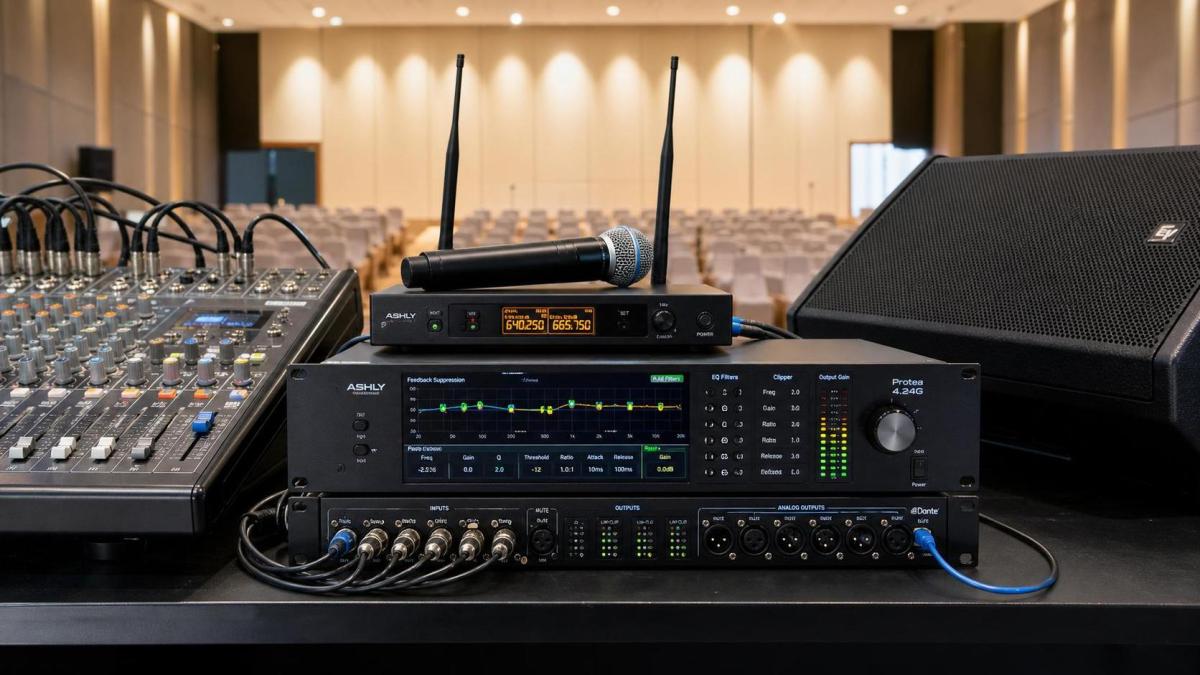
Feedback rarely starts because one setting suddenly failed. It usually appears when gain structure, microphone position, loudspeaker coverage, and room reflections drift out of balance.
That is why Feedback Suppression should be treated as a fast control tool, not a substitute for system tuning.
In service work, ringing often shows up after a moved monitor, a replaced wireless microphone, a firmware reset, or a different stage layout.
Small changes matter. A few degrees of microphone angle or a little extra send level can push one narrow frequency into a loop.
Across live sound, worship rooms, theaters, studios, and education spaces, the pattern is similar: the room and the signal path interact faster than expected.
PMAS often frames this as a system behavior question. Acoustic physics, DSP tuning, loudspeaker directivity, and operator workflow all affect how quickly feedback builds.
So the first practical question is not only, “Which filter should I use?” It is also, “What changed since the last stable setup?”
Which Feedback Suppression settings usually stop ringing the fastest?
For fast recovery, the most useful starting point is a mix of fixed filters and live filters.
Fixed filters catch repeat problem frequencies during setup. Live filters stay available for unexpected peaks during operation.
A practical baseline often looks like this:
- Use 50% to 70% of available filters as fixed filters during ring-out.
- Reserve the remaining filters for dynamic suppression.
- Start with narrow bandwidth, especially for speech systems.
- Use moderate detection speed, then increase only if feedback rises too fast.
- Set release time carefully so filters do not move too often.
Narrow filters are usually the safest first move. They reduce ringing while preserving more tonal detail in vocals, instruments, and playback.
Very fast detection can help during urgent service calls, but it has a tradeoff. If sensitivity is too high, normal program content may trigger unnecessary filtering.
That becomes more obvious with music playback, brass, guitar cabinets, or percussive transients, where strong harmonics can be misread.
When Feedback Suppression is configured well, it buys time. It should not keep chasing new frequencies every few seconds.
A quick settings guide for field decisions
The table below works as a fast reference when ringing must be controlled without rebuilding the whole mix.
How do you choose between fixed filters, live filters, and deeper EQ changes?
This choice depends on whether the problem is stable, moving, or structural.
If the same tone rings every time a microphone reaches working level, fixed Feedback Suppression filters are usually the cleanest response.
If feedback appears only when performers move, when presenters turn toward a loudspeaker, or when monitor sends change, live filters make more sense.
When the system keeps fighting multiple frequencies, the problem often sits deeper than suppression can solve alone.
That is the point to review:
- Microphone pattern and aim
- Monitor loudspeaker position
- Graphic or parametric EQ already in the path
- High-frequency shelving and presence boosts
- Room reflections from walls, lecterns, or stage floors
In practical terms, Feedback Suppression is strongest when it supports a stable electroacoustic design. It becomes weaker when it is asked to compensate for poor coverage or aggressive gain.
That distinction matters in line array systems, distributed ceiling speakers, portable PA rigs, and smaller installed zones. Each behaves differently under stress.
What settings protect clarity instead of making the system sound thin?
The common mistake is assuming more suppression means more safety. In reality, too many active filters can flatten speech intelligibility and remove musical presence.
A better target is controlled stability with minimal intervention.
To preserve tone, keep these points in mind:
- Use the narrowest practical notch width first.
- Limit the maximum number of automatic cuts.
- Avoid stacking suppression on top of heavy graphic EQ cuts.
- Reset and re-ring systems after major layout changes.
- Compare bypass and active sound before leaving site.
This is especially important in venues that host both speech and music. Settings that work well for spoken word can be too aggressive for full-range program material.
Digital consoles, DSP processors, and networked audio platforms make it easy to store presets, but presets should not be treated as universal answers.
Rooms change with occupancy, stage furniture, drapery, and loudspeaker substitutions. Feedback Suppression settings should reflect those variables, not ignore them.
This is one reason PMAS content often connects DSP behavior with room acoustics. Suppression quality depends on both.
When is Feedback Suppression masking a bigger fault?
If filters fill up quickly, or if ringing returns after every reset, something more basic probably needs attention.
A suppression processor cannot correct all of these issues:
- Incorrect amplifier or processor gain structure
- A failed HF driver changing system response
- Polarity errors in loudspeaker zones
- A damaged microphone capsule
- Excessive compression increasing feedback tendency
- Poorly aimed fills or delay speakers
One useful field check is simple: bypass suppression briefly at a controlled level and compare system behavior with the known baseline.
If the system becomes unstable much earlier than expected, measure before adding more filters. FFT tools, transfer function checks, and loudspeaker verification can save repeated call-backs.
In touring, rental, and installed environments, repeated emergency filtering often hides a maintenance issue rather than solving it.
What is the fastest service workflow when time is limited?
When a room is already live and time is short, speed comes from sequence, not guesswork.
A reliable workflow is usually this:
- Confirm the problem source channel, bus, or monitor send.
- Check microphone position and loudspeaker aim before touching DSP.
- Verify gain structure and remove accidental boosts.
- Apply or refresh fixed Feedback Suppression filters.
- Reserve several live filters for operational changes.
- Listen for tonal damage, then store the revised preset clearly.
That sequence works because it separates immediate control from root-cause correction.
It also reduces the risk of leaving behind a system that seems stable, yet sounds worse or fails under different content.
For systems with digital networking, document the processor state, firmware version, and scene recall behavior. A reset can undo good Feedback Suppression work if those details are missed.
How should the next setup be prepared so ringing does not come back?
The best long-term result comes from turning each service call into a better baseline.
Keep records of the ringing frequency ranges, room layout, microphone models, loudspeaker presets, and final Feedback Suppression settings.
That history helps identify whether the issue is venue-related, hardware-related, or operational.
It also improves comparison across venues such as theaters, houses of worship, lecture spaces, portable stages, and recording rooms with talkback systems.
In many cases, the next useful step is not adding more DSP. It is refining mic selection, loudspeaker coverage, acoustic treatment, or preset governance.
Feedback Suppression works fastest when the rest of the sound system already respects acoustic and gain limits.
If repeated ringing continues, build a short review list: measure the room response, compare suppression behavior across presets, and confirm whether the current setup still matches the original design intent.
That approach keeps the system professional, stable, and easier to support over time.
Related Intelligence
 Bass Traps & DiffusersAug 11, 2026Studio Bass Trap Design: How Placement and Thickness Affect Low-End ControlStudio bass trap design explained: learn how corner placement, rear-wall treatment, and trap thickness improve low-end accuracy, reduce bass buildup, and help your mixes translate better.
 Feedback Suppression DSPAug 11, 2026EN 18031-2 Takes Effect for Wireless Audio DSPEN 18031-2 takes effect for wireless audio DSP, making CE-RED, TLS 1.2+, and DoC readiness critical. Learn how it impacts exports, firmware, and EU market access.
 AoIP Network ProtocolsAug 10, 2026Audio over IP Integration: How to Balance Latency, Redundancy, and ScalabilityAudio over IP integration explained for real-world projects: learn how to balance latency, redundancy, and scalability to build reliable, future-ready professional audio networks.
 Broadband Acoustic PanelsAug 10, 2026EU CE Rule Takes Effect for Acoustic ProductsEU CE Rule Takes Effect for Acoustic Products: learn how EN 1793-5:2026, Class B-s1,d0 testing, and CE marking reshape EU imports, compliance, and delivery planning.
 Touring CAPEX & Acoustic ROIAug 09, 2026Concert Hall Acoustic Design Planning: How to Balance RT60, Clarity, and BudgetConcert hall acoustic design planning made practical: learn how to balance RT60, clarity, room use, and budget to compare solutions wisely and avoid costly acoustic mistakes.
 CE/FCC & CITES Wood RegsAug 09, 2026CITES Annex II Permit Rule Expands for Brazilian RosewoodCITES Annex II permit rule expands for Brazilian rosewood, reshaping export compliance, sourcing, and customs checks. Learn what Dalbergia nigra traders must review now.
 Digital Live Mixing ConsolesAug 08, 2026How to Evaluate a Live Event Production Technology Supplier for System Reliability and ScalabilityLive event production technology supplier evaluation made practical: learn how to verify reliability, scalability, interoperability, and support before choosing a system for demanding events.
 Class-D Digital AmplifiersAug 08, 2026EU CE Rule Adds 96 kHz EMC Requirement for Audio AmplifiersEU CE Rule Adds 96 kHz EMC Requirement for Audio Amplifiers. Learn how EN 55032:2026/A2:2026 impacts CE marking, export compliance, testing timelines, and EU shipment readiness.
 CE/FCC & CITES Wood RegsAug 07, 2026What CE Marking for Percussion Instruments Covers and the Documents Importers NeedPercussion instruments CE requirements vary by design, electronics, toy status, and market use. Learn what CE marking covers and which importer documents you should verify before ordering.
 CE/FCC & CITES Wood RegsAug 07, 2026CITES Annex II Rule Tightens Dalbergia nigra ExportsCITES Annex II rule tightens Dalbergia nigra exports from Aug 7, 2026. Learn how permit checks, legal harvest proof, and customs compliance will impact wood parts trade.
 Digital Live Mixing ConsolesAug 06, 2026Live Sound Technology Trends Shaping Console and PA UpgradesLive sound technology trends reshaping console and PA upgrades: explore lower latency, smarter DSP, audio networking, and scalable systems that improve ROI, control, and uptime.
 Broadband Acoustic PanelsAug 06, 2026EU CE Rule Tightens for Acoustic ProductsEU CE rule tightens for acoustic products under EN ISO 16283-1:2026. Learn how new testing, certification, and CE marking changes may impact EU market access.
 Class-D Digital AmplifiersAug 05, 2026How to Verify CE Compliance for Class-D Amplifiers Before ImportClass-D amplifiers CE checks go beyond the logo. Learn how to verify DoC, EMC, safety reports, labels, and revisions before import to reduce EU customs and compliance risk.