CITES Expansion Tightens Guitar Component Trade
On June 28, 2026, a CITES Secretariat emergency notice introduced an immediate compliance change for the guitar supply chain: Appendix I controls for Brazilian rosewood (Dalbergia nigra) now extend to semi-finished components such as necks and fingerboards, including cases where those parts are used together with Carbon Fiber Acoustic Guitars. For manufacturers, exporters, importers, and sourcing teams, the issue is no longer limited to finished instruments or raw timber. It now reaches component sourcing, export documentation, approval timing, and buyer-side material review, which is why the update deserves close attention across trade and production planning.
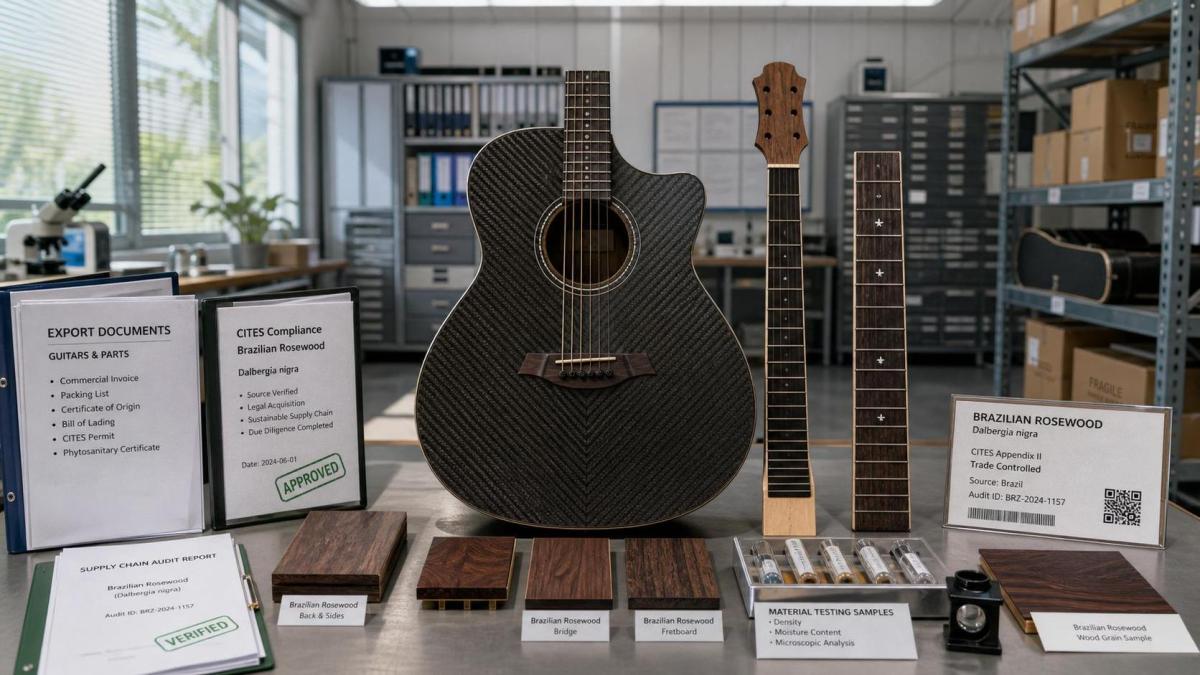
What the June 28 notice changed in practice
The CITES Secretariat issued Emergency Notice No. 2026/047 on June 28, 2026. According to the notice, the Appendix I control scope for Brazilian rosewood has been expanded with immediate effect to cover semi-finished components containing that wood, including guitar necks and fingerboards. The summary provided also states that this scope applies regardless of whether such components are combined with Carbon Fiber Acoustic Guitars.
For Chinese carbon fiber guitar manufacturers, exports involving the affected material now require an NDF and an export permit from the CITES Management Office. The average approval cycle is stated as 22 working days. In parallel, several EU importers have already started supply-chain audits focused on substitute wood sourcing.
Where the pressure is likely to appear first
Component sourcing is moving into the compliance front line
From an industry perspective, companies purchasing necks, fingerboards, or other semi-finished parts may be affected first because the rule change reaches into components rather than only complete products. The practical impact is likely to appear in material identification, supplier declarations, and procurement screening for parts that may contain Brazilian rosewood.
Export scheduling now has a document-driven constraint
Analysis shows that export-facing manufacturers and trading companies need to pay particular attention to the stated requirement for an NDF and an export permit. With an average approval cycle of 22 working days, the main business effect may fall on shipment scheduling, customer delivery commitments, and internal production-release timing where affected components are involved.
Buyer-side review is expanding beyond product specifications
Observably, the start of substitute wood supply-chain audits by several EU importers indicates that importer review is extending beyond product performance and into upstream material traceability. For channel partners and procurement teams, this may translate into added scrutiny of supplier qualifications, material records, and consistency between product documents and actual component composition.
Operational points companies should watch now
Review whether semi-finished parts are within current shipment scope
What deserves closer attention is whether existing export plans include necks, fingerboards, or other semi-finished parts containing Brazilian rosewood. Even where the final product is a Carbon Fiber Acoustic Guitar, the provided summary indicates that mixed use does not remove the control requirement.
Recheck document readiness against the approval timeline
Analysis shows that companies handling affected exports should focus on the readiness of NDF-related materials and export permit applications. The stated 22-working-day average approval period does not by itself define every case outcome, but it is a concrete timing factor that may need to be reflected in order confirmation, production planning, and customer communication.
Prepare for substitute-material scrutiny from overseas buyers
Observably, the launch of substitute wood supply-chain audits by several EU importers suggests that buyer questions may increasingly cover alternative material sourcing, supplier consistency, and traceability support. Companies may need to examine whether their technical files, procurement records, and supplier information are aligned well enough to answer those reviews.
Keep watching for execution wording and downstream document changes
Because the input does not provide more detailed implementation rules, it is more appropriate to understand current action points as compliance watch items rather than settled operating standards in every transaction scenario. Firms should therefore monitor later official wording, customer-side documentation requests, and any changes in trade paperwork or bid documents connected to affected components.
Why this reads as an execution signal, not just a policy headline
In editorial observation, this update is better understood as an immediate execution signal because the summary specifies that the expanded scope applies from the date of notice and identifies concrete permit requirements and an average approval period. At the same time, it would be premature to treat all downstream trade outcomes as fully settled, since the provided information does not describe detailed enforcement scenarios, exemption handling, or how individual buyers will standardize their review thresholds.
From an industry perspective, the more significant point is that control attention has moved deeper into component level. That tends to affect routine business processes such as sourcing checks, export file preparation, and delivery coordination earlier than broader market statistics or long-range demand judgments can be confirmed.
How the market should read this stage
Analysis shows that this development should currently be read as a landed compliance change with immediate operational relevance, especially for companies dealing with guitar components, export shipments, and overseas buyer audits linked to Brazilian rosewood. It is not yet a basis for broad conclusions about final market restructuring, but it is clearly a signal that material composition, licensing readiness, and substitute sourcing verification are becoming more central to cross-border execution.
Basis of this article and what still needs verification
This article is generated based on the user-provided news title, event date, and event summary. For developments of this kind, relevant source types commonly include official notices, releases from regulatory authorities, customs or trade administration information, industry association updates, standards-related documents, and reporting by authoritative trade media. A specific official source link was not provided in the input, so the underlying notice text and any later implementation details still require ongoing verification. What should continue to be monitored includes detailed policy wording, certification and permit execution practice, changes in bid or procurement documents, buyer-side audit expectations, industry feedback, and company-level implementation progress.
Related Intelligence
 Digital Live Mixing ConsolesAug 14, 2026How audio engineering services affect live sound clarity and mix controlAudio engineering services shape live sound clarity and mix control, helping venues achieve intelligible, balanced, and repeatable results.
 CE/FCC & CITES Wood RegsAug 14, 2026CITES Wood Rules Take Effect Aug. 1: Maple Drums, Spruce Guitar Panels Need Approval CodesCITES wood rules take effect Aug. 1, 2026—learn which maple drum shells and spruce guitar panels need approval codes, plus key customs filing steps.
 Broadband Acoustic PanelsAug 13, 2026How sound coverage services improve speech clarity in large venuesSound coverage services improve speech clarity in large venues by optimizing speaker placement, delay, and tuning for clear, consistent announcements that keep every seat engaged.
 Class-D Digital AmplifiersAug 13, 2026EU Tightens CE Rules for Class-D AmpsEU tightens CE rules for Class-D amps, requiring EN 62368-1:2024 and EN 55032:2024 dual compliance. Learn what exporters, distributors, and buyers must check now.
 Active DSP Line ArraysAug 12, 2026How to Size Line Array PA Systems for Venue Coverage and SPL TargetsLine array PA Systems sizing guide: learn how to match venue coverage, SPL targets, headroom, subs, and rigging limits for clearer sound and smarter system decisions.
 Carbon Fiber Acoustic GuitarsAug 12, 2026CITES Adds All Pterocarpus Species to Annex IICITES adds all Pterocarpus species to Annex II, tightening permit control for rosewood guitars and global trade compliance. Learn what manufacturers and buyers must do now.
 Bass Traps & DiffusersAug 11, 2026Studio Bass Trap Design: How Placement and Thickness Affect Low-End ControlStudio bass trap design explained: learn how corner placement, rear-wall treatment, and trap thickness improve low-end accuracy, reduce bass buildup, and help your mixes translate better.
 Feedback Suppression DSPAug 11, 2026EN 18031-2 Takes Effect for Wireless Audio DSPEN 18031-2 takes effect for wireless audio DSP, making CE-RED, TLS 1.2+, and DoC readiness critical. Learn how it impacts exports, firmware, and EU market access.
 AoIP Network ProtocolsAug 10, 2026Audio over IP Integration: How to Balance Latency, Redundancy, and ScalabilityAudio over IP integration explained for real-world projects: learn how to balance latency, redundancy, and scalability to build reliable, future-ready professional audio networks.
 Broadband Acoustic PanelsAug 10, 2026EU CE Rule Takes Effect for Acoustic ProductsEU CE Rule Takes Effect for Acoustic Products: learn how EN 1793-5:2026, Class B-s1,d0 testing, and CE marking reshape EU imports, compliance, and delivery planning.
 Touring CAPEX & Acoustic ROIAug 09, 2026Concert Hall Acoustic Design Planning: How to Balance RT60, Clarity, and BudgetConcert hall acoustic design planning made practical: learn how to balance RT60, clarity, room use, and budget to compare solutions wisely and avoid costly acoustic mistakes.
 CE/FCC & CITES Wood RegsAug 09, 2026CITES Annex II Permit Rule Expands for Brazilian RosewoodCITES Annex II permit rule expands for Brazilian rosewood, reshaping export compliance, sourcing, and customs checks. Learn what Dalbergia nigra traders must review now.
 Digital Live Mixing ConsolesAug 08, 2026How to Evaluate a Live Event Production Technology Supplier for System Reliability and ScalabilityLive event production technology supplier evaluation made practical: learn how to verify reliability, scalability, interoperability, and support before choosing a system for demanding events.