Huamei Gains EN ISO 11654:2026 Certification
The timing of the underlying event is not explicitly stated in the available information, but the June 10, 2026 announcement from Huamei Energy Saving Technology Group is notable because it links a product certification result to a concrete standards change in acoustic performance grading. For manufacturers, exporters, specifiers, procurement teams, and certification-related service providers, the development deserves attention as it suggests that updated testing and classification requirements under EN ISO 11654:2026 may begin to matter more directly in supplier qualification, technical documentation, and access to higher-specification project chains.

What the announcement confirms
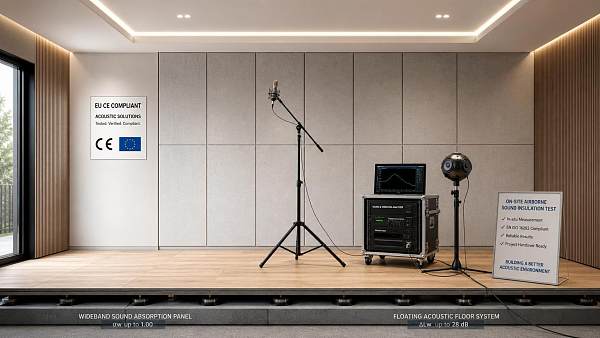
Huamei Energy Saving Technology Group announced on June 10, 2026 that its Broadband Acoustic Panels series passed certification under the latest EN ISO 11654:2026 standard, titled Acoustic — Sound absorption materials and structures — Measurement of sound absorption coefficient — Performance classification. According to the provided summary, Huamei is among the first domestic companies to obtain this certification.
The confirmed rules change in the summary is twofold. First, the new standard expands acoustic absorption performance grading from five levels under the previous version to eight levels, covering αw values from 0.15 to 1.00. Second, it introduces an assessment of average sound absorption across a broad frequency range of 100–5000Hz.
The summary also states that this certification directly supports the company’s product entry into supply chains serving high-end theaters, recording studios, and LEED-certified projects in the European Union.
Why the standards shift matters in commercial practice
Specification-driven manufacturers may face a higher proof burden
From an industry perspective, manufacturers of acoustic panels and related materials may be affected because the move from a five-grade to an eight-grade structure can make performance classification more granular in technical comparison. The practical impact may appear in product positioning, test report presentation, bid documentation, and specification alignment where buyers increasingly compare not only whether a product is certified, but how it performs within the updated grading framework.
What deserves closer attention is whether product literature, sample books, and technical submittals are fully aligned with the new classification language and the broader frequency-range assessment referenced in the standard summary.
Export-facing suppliers may see certification become a market access filter
For export-oriented suppliers, the stated link to European Union high-end theaters, recording studios, and LEED-certified project supply chains indicates that certification is not only a technical label but also a trade-facing compliance asset. The impact may be felt in prequalification, contract review, and customer acceptance, especially where procurement documents require evidence that product testing and classification match the latest applicable standard.
Analysis shows that exporters should pay close attention to whether customers begin updating tender wording, approved-vendor requirements, or supporting document lists to reflect EN ISO 11654:2026 rather than earlier versions.
Procurement and project teams may need tighter document review
Procurement teams, specifiers, and project delivery parties may be affected because a revised standard can change how acoustic claims are compared across suppliers. In practice, this may influence supplier selection, document verification, and handover materials, particularly for projects where acoustic performance is tied to premium-use scenarios or green-building requirements.
Observably, buyers may need to check whether test reports, certification statements, and product data sheets clearly correspond to the updated grading system and the wide-band average absorption assessment described in the announcement summary.
Testing and certification services may need closer wording consistency
Certification-related businesses and testing service providers may also be affected because standards updates often increase the importance of precise report wording, standard-version references, and consistency between laboratory results and commercial claims. The main compliance focus here is less about general promotion and more about ensuring that the cited standard, grading method, and declared performance are presented without ambiguity.
Where companies should focus next
Check version alignment across all compliance materials
Companies with acoustic panel products should review whether certificates, test reports, product datasheets, and bid attachments consistently reference EN ISO 11654:2026 where applicable. Analysis shows that mismatched version references can become a practical issue when customers compare suppliers under updated technical requirements.
Watch for changes in tender and supplier qualification language
Because the summary links certification to access to high-end and LEED-related supply chains, businesses should watch for changes in tender documents, approved material lists, and supplier qualification requests. It is more appropriate to understand this as an area requiring monitoring rather than as proof that all downstream procurement documents have already shifted.
Prepare for broader scrutiny of performance presentation
The addition of broad-frequency average absorption assessment means companies should pay attention to how performance claims are described in sales and technical materials. What deserves closer attention is whether internal product descriptions, third-party documents, and customer-facing submissions use the same performance basis and avoid overstating what the certification confirms.
Review delivery and after-sales traceability expectations
For suppliers entering more specification-sensitive projects, it is prudent to review how certification-related materials accompany shipments and post-delivery support. Observably, document traceability, version control, and consistency between supplied goods and certified product scope may become more important where customers rely on certification for acceptance or project compliance files.
How this should be read at this stage
Analysis shows that this development is better understood as an execution signal tied to a standards update rather than as a complete picture of market-wide adoption. The confirmed fact is that a domestic manufacturer has obtained certification under the latest EN ISO 11654:2026 framework and that the new version introduces more detailed grading and broad-frequency assessment.
What remains worth watching is how quickly that standards change is reflected in procurement language, project specifications, certification review practice, and supplier competition. From an industry perspective, the announcement matters because it shows how a technical standard revision can move from document language into practical market access.
A measured reading of the announcement
This case highlights a specific kind of rules change that industry participants often need to track closely: a revised technical standard that can influence certification value, supply-chain entry, and the comparability of product claims. The most reasonable interpretation at present is not that the market has fully reset, but that a clearer compliance and specification signal is emerging for acoustic panel suppliers serving higher-end or more documentation-sensitive projects.
Basis of this article
This article is generated from the user-provided news title, event timing field, and event summary. The specific official source link was not provided in the input, so continued verification is still necessary.
For developments of this kind, commonly relevant source types may include company announcements, regulatory releases, trade or customs authority information, industry association updates, standard-setting organization documents, and reporting by established industry media. Further observation is still needed on detailed implementation language, certification interpretation, tender document changes, market feedback, and how companies apply the new standard in actual delivery and supply-chain qualification.
Related Intelligence
 Digital Live Mixing ConsolesAug 02, 2026How to Choose a Live Digital Mixing Console for Channel Count, I/O, and Scene RecallLive digital mixing console buying guide: learn how to evaluate true channel count, local and stage I/O, patching, and scene recall to choose a reliable system with confidence.
 Feedback Suppression DSPAug 02, 2026EU Updates EMC Rule for Audio Gear, Retesting RequiredEU updates EMC rule for audio gear: digital mixers, DSP units, and Class-D amplifiers may need retesting by Feb 1, 2027. See how the new EU EMC standard impacts compliance, inventory, and shipments.
 Active DSP Line ArraysAug 01, 2026Sound Reinforcement Coverage Optimization: How to Reduce Dead Zones in Wide VenuesSound Reinforcement Coverage Optimization: learn how to reduce dead zones in wide venues with smarter aiming, directivity control, delay alignment, and audience-focused design checks.
 Carbon Fiber Acoustic GuitarsAug 01, 2026CITES Annex II Update Tightens Guitar Export ComplianceCITES Annex II update tightens guitar export compliance as new controls on substitute wood affect permits, traceability, and shipments to the EU, Japan, and the U.S.
 Touring CAPEX & Acoustic ROIJul 31, 2026What Drives Audio Systems Engineering Cost in Large Venue Installations?Audio systems engineering cost in large venue installations is driven by acoustics, rigging, networking, labor, and commissioning. Learn what shapes budgets and compare proposals with confidence.
 AoIP Network ProtocolsJul 31, 2026EU Tightens CE Rules for AoIP Audio DevicesEU Tightens CE Rules for AoIP Audio Devices: learn how new AES67 interoperability and EMC reporting requirements may affect exports, certification, and market access before October 2026.
 Touring CAPEX & Acoustic ROIJul 30, 2026When Do Audio Workflow Services Improve Turnaround and Cost Control?Audio workflow services improve turnaround and cost control when volume, revisions, and approvals create hidden delays. Learn the clear signs, savings drivers, and best-fit use cases.
 CE/FCC & CITES Wood RegsJul 30, 2026Brazilwood Trade Now Needs FSC and CITES PapersBrazilwood trade now needs FSC and CITES papers from July 29, 2026. Learn how the new Annex II rule affects exports, customs timing, and instrument supply chains.
 Touring CAPEX & Acoustic ROIJul 29, 2026How to Compare Professional Sound Reinforcement Services for Venue Size, Coverage, and BudgetProfessional sound reinforcement services compared the smart way: learn how to evaluate venue size, coverage, integration, and budget for clearer sound and better long-term ROI.
 Broadband Acoustic PanelsJul 29, 2026EU CE Rule Requires On-Site Sound Insulation VerificationEU CE Rule now requires on-site sound insulation verification for acoustic products under EN ISO 16283-1:2026. Learn how exporters and suppliers can adapt faster to protect EU project compliance.
 Feedback Suppression DSPJul 28, 2026Portable PA Systems for Church: How to Choose Clear, Feedback-Resistant SoundPortable PA Systems for church buying starts with clear speech, stable wireless use, and strong feedback resistance. Learn how to compare room fit, DSP, portability, and volunteer-friendly setup.
 Carbon Fiber Acoustic GuitarsJul 28, 2026CITES Annex II Listing Tightens Carbon-Fiber Guitar ExportsCITES Annex II listing tightens carbon-fiber guitar exports from China. Learn how new permit, legal-origin, and due diligence rules may affect EU, US, and Japan shipments.
 Bass Traps & DiffusersJul 27, 2026Recording Technology for Studios: What Actually Improves Sound Quality?Recording technology for studios explained clearly: discover what truly improves sound quality, from room acoustics and mic placement to monitoring, converters, and workflow.